Software Is a Proxy. AI Makes It Obsolete.
Why dashboards, workflows, and "products" as we know them won't survive the next decade.

Every piece of B2B software ever built exists for one reason: humans can’t hold enough information in their heads.
A project manager can’t track 500 tasks, their dependencies, their statuses, and their blockers simultaneously. So we built Jira. A salesperson can’t remember every interaction with every prospect. So we built CRM systems. Accountants, HR teams, marketers, all the same story. We kept building structured tools to compensate for the limits of human memory and attention.
Every SaaS product is fundamentally a structured information proxy for humans. The UI, the database schema, the workflow engine, all of it exists because humans need structure to process information.
Now ask the uncomfortable question: what happens when AI doesn’t have those limitations?
An AI can hold the entire context of 500 tasks, their dependencies, every conversation that created them, every commit that relates to them, and every team member’s workload. Simultaneously. In memory. Without a database UI. It doesn’t need a kanban board to “see” the work. It doesn’t need a pipeline view to “understand” the sales funnel. It doesn’t need a trial balance to “know” the financial position.
The proxy becomes unnecessary. And that means the product as a category starts to dissolve.
Three eras of software
Era 1 (1980–2010): Software as a tool.
You operate it. Excel. Photoshop. Tally. AutoCAD. The human does the work, the software is the instrument. A master of Excel is more productive than a novice. You pay for what the software can do.
Era 2 (2010–2025): Software as a system.
You configure it. Salesforce. Jira. HubSpot. Workday. The human designs workflows, sets up automations, defines rules. The software executes them at scale. The skill shifts from operating to configuring. An entire consulting industry emerges around “Salesforce implementation” and “Jira administration.”
You pay for processes the software runs.
Era 3 (2025–???): Software as an agent.
You direct it. State the outcome. The AI figures out the process, executes the work, reports back. No configuration. No workflow design. No administration.
You pay for work done.
We’re at the very beginning of Era 3. Most of the industry hasn’t figured out what that means yet.
I run a technology company. I’ve spent the last year watching our own clients ask for AI-native rebuilds of tools they’ve used for a decade. Not “add a chatbot.” Rebuild it. That’s the signal.
The Proxy Stack
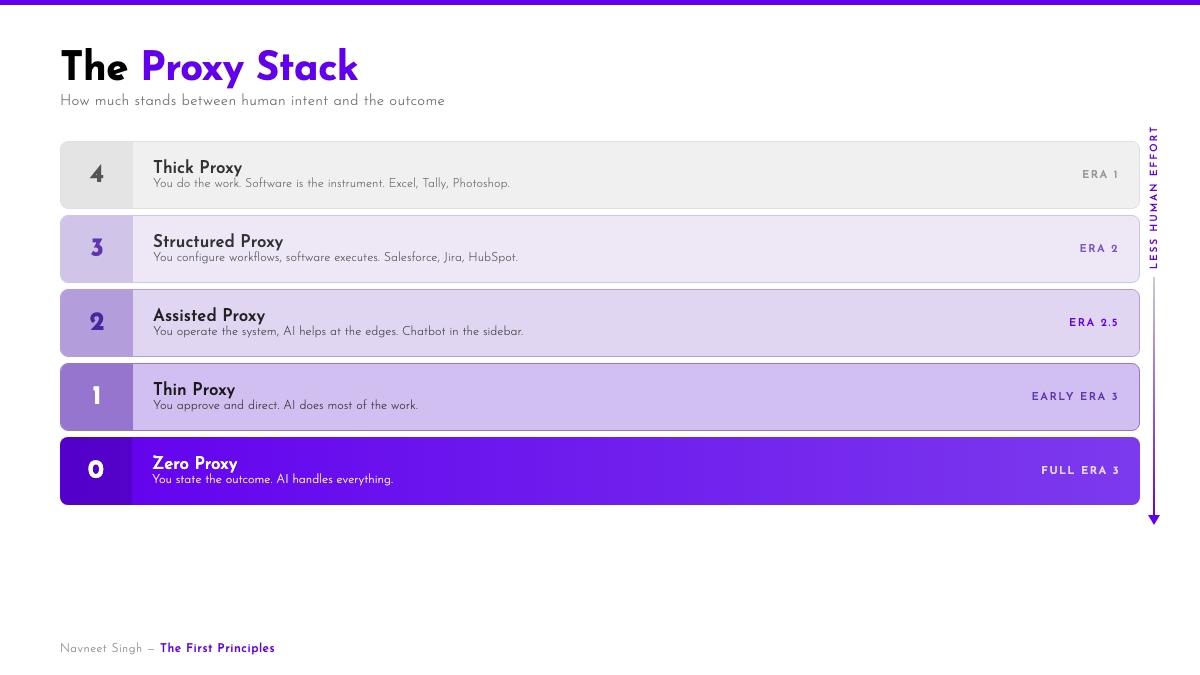
I think about this as layers. Every piece of software sits somewhere on what I call the Proxy Stack: how much stands between a human’s intent and the outcome they want.
Layer 4 — Thick Proxy. You do the work, software is the instrument. Excel, Tally, Photoshop. (Era 1)
Layer 3 — Structured Proxy. You configure workflows, software executes. Salesforce, Jira, HubSpot. (Era 2)
Layer 2 — Assisted Proxy. You operate the system, AI helps at the edges. Chatbot in the sidebar, auto-generated summaries. (Era 2.5)
Layer 1 — Thin Proxy. You approve and direct, AI does most of the work. (Early Era 3)
Layer 0 — Zero Proxy. You state the outcome, AI handles everything. (Full Era 3)
Most of the SaaS industry right now is fighting over the move from Layer 3 to Layer 2. They’re calling it transformation. It’s a one-layer improvement while the market is heading to zero.
The interesting question for any software product becomes simple: what layer are you on, and how fast are you moving down?
The Era 2.5 trap
Right now, every SaaS company is bolting AI onto their existing product. A chatbot in the sidebar. An “AI insights” panel. Auto-generated summaries. Content suggestions.
They’re calling this “AI-powered.” It’s not. It’s Era 2 software with Era 3 marketing. Layer 3 products wearing a Layer 2 costume.
The fundamental architecture hasn’t changed. The database schema is the same. The UI is the same. The workflow engine is the same. The user still needs to create records, update statuses, configure automations, and navigate dashboards. The AI is a feature, not the foundation.
I call this Era 2.5. And it’s a trap, because it gives incumbents the illusion of transformation while leaving them structurally vulnerable to genuine Layer 1 and Layer 0 products.
The pattern is familiar. When the web emerged, most software companies built a “web portal” on top of their existing client-server architecture. It looked modern. It wasn’t. Salesforce, a true web-native architecture, ate their lunch. When mobile emerged, most companies built “responsive” versions of their desktop UIs. Instagram, Uber, WhatsApp didn’t do that. They were mobile-native from the ground up and created entirely new categories.
The same structural displacement is beginning now. It’s already starting. Klarna replaced 700 customer service agents with AI and reported the same satisfaction scores. Harvey is handling legal research that junior associates used to do. Cursor and similar tools are writing production code that ships without human review. These aren’t experiments. They’re early Layer 1 products eating into Layer 3 territory.
What Layer 0 products actually look like
The UI collapses
A Layer 0 product might not have a traditional UI at all. Not “minimal UI,” potentially no persistent visual interface. The interaction model is conversational plus notifications plus generated artifacts.
You don’t “open the project management tool.” You ask “what should I focus on today?” and get an answer that pulls from projects, calendar, team capacity, and deadlines. The answer IS the product.
You don’t “check the CRM.” The CRM tells you, unprompted, that your biggest prospect hasn’t responded in 12 days and drafts a follow-up referencing their Q3 budget cycle.
The entire concept of “logging into software” becomes as archaic as “dialling up the internet.”
Now, “no UI” taken literally is an overcorrection. Humans are visual. Even at Layer 0, people will want to see their financial position, see their project timeline. The difference is that these visualisations are generated on demand, not pre-built dashboards you navigate to. You won’t click through “Reports > Financial > P&L > FY 2026.” You’ll say “show me how we’re doing financially” and get something tailored to your context. The UI isn’t dead. It’s generated, not designed. Ephemeral, not permanent.
The database becomes invisible
At Layer 3, users interact with structured data through forms and views. Create a contact. Update a deal stage. Change a task status. Every interaction is a human translating reality into a structured record.
At Layer 0, the AI maintains structured data as a side effect of understanding unstructured reality. A conversation happened on WhatsApp, the AI extracted a task, identified the owner, estimated the effort, slotted it into the sprint. A payment arrived in the bank account, the AI matched it to an invoice, updated receivables, adjusted the cash flow forecast.
The database still exists. But no human ever touches it directly. It’s the AI’s memory, not the user’s interface.
This single shift eliminates the number one complaint about every B2B tool in existence: the overhead of keeping it updated. Nobody hates managing projects. They hate maintaining the project management tool. Nobody hates tracking sales. They hate updating the CRM. The administrative tax of structured data entry is universal friction. Layer 0 removes it entirely.
Products merge into agents
If the UI is conversational and the database is invisible, what actually separates a “PM tool” from a “CRM” from an “accounting system”?
At Layer 3, they’re different products because they have different UIs, different data models, different workflows. You switch between applications. You export from one and import into another. You build integrations to connect them.
At Layer 0, they’re different capabilities of the same agent. “Follow up with the client” is a CRM action. “Create the invoice for that deal” is an accounting action. “Assign the implementation to the engineering team” is a PM action. But to the user, it’s one continuous conversation with one system that understands the full context.
The concept of “software categories” dissolves. CRM, ERP, HRM, PM become capabilities, not products. And the company that assembles the most comprehensive set of capabilities into a single coherent agent wins the entire enterprise software market.
Though I’d push back on myself here: some domains will resist this merger for a long time. Finance, HR, legal, healthcare, anywhere errors carry regulatory or legal consequences, the trust curve is steep. An engineer might accept AI auto-creating tasks from Day 1. A CFO won’t trust AI to auto-file tax returns until it’s proven correct for 12 consecutive months. That’s not irrational resistance. It’s appropriate caution with real stakes.
The moat shifts from product to data
At Layer 3, the moat is the product: features, integrations, ecosystem, brand. Salesforce’s moat is its AppExchange ecosystem and millions of trained admins. Jira’s moat is deep integration with the Atlassian suite and the inertia of enterprise workflows built around it.
At Layer 0, the product layer commoditises. AI can generate UIs dynamically. Workflows configure themselves. Integrations are just API calls that an agent handles. The traditional product moat erodes.
What replaces it is accumulated domain intelligence.
An AI that has processed 10,000 Indian SMB accounting datasets understands GST edge cases that a generic AI never will. An AI that has managed 5,000 engineering sprints predicts blockers with precision a new entrant can’t match. Features can be copied overnight. Domain intelligence compounds over years.
The implication for builders: your first 1,000 customers aren’t revenue. They’re your dataset. The competitive distance between you and a new entrant is measured in accumulated learning, not feature parity.
The interaction frequency inverts
This one challenges every SaaS metric we’ve been taught to worship.
Layer 3 products optimise for engagement. Daily active users. Time-in-app. Sessions per day. Product teams celebrate when users spend more time in their tool. Growth teams optimise for habit formation. The entire product strategy assumes that a “sticky” product is a good product.
Layer 0 inverts this completely.
The best AI agent is the one you interact with the least, because it’s handling everything autonomously. A project management system that requires zero daily interaction beats one that requires 30 minutes. An accounting system that needs one approval per day beats one demanding 2 hours of data entry.
Success is measured by the absence of human involvement, not its presence.
This breaks every SaaS business metric. DAU becomes meaningless. Time-in-app becomes a failure indicator. The companies that figure out new metrics (tasks autonomously completed, decisions made without human intervention, exceptions per 1,000 transactions) will build the products that actually matter.
The north star for Layer 0: how much valuable work happened without anyone touching the product today?
And if engagement metrics break, pricing does too. Per-seat makes no sense when AI does the work of five people. The model shifts to outcomes: per transaction processed, per ticket resolved, per project managed. You pay for work done, not tools provided.
What this means if you’re building
If you’re building B2B software today, the strategic question isn’t “what features should we add?” It’s where are you on the Proxy Stack, and how fast are you moving down?
Sitting at Layer 3? Your window is closing. Not today, not this year, but within 3-5 years, Layer 1 alternatives will begin displacing products that require manual data entry, workflow configuration, and dashboard navigation.
Moving from Layer 3 to Layer 2? You’re buying time, not building a moat. The AI chatbot in your sidebar doesn’t change the fundamental architecture. Use the time well. Start rebuilding the foundation, not the facade.
Building for Layer 0 from scratch? You have the structural advantage but face the distribution disadvantage. Incumbents have millions of users, thousands of integrations, and decades of trust. Your product needs to be dramatically better on the one dimension that matters most: elimination of human effort.
And if you’re not building software but running a business on it? Start asking your vendors a different question. Not “what features are on the roadmap” but “when does your product stop needing me to operate it?”
The transition will be slow and messy. Spreadsheets didn’t kill paper ledgers in a year. SaaS didn’t kill on-premise in a year. Layer 0 won’t kill Layer 3 in a year either. Hybrid products will dominate the market for a while. Pure autonomous products will work for some use cases and fail for others.
But the direction is clear. The human-in-the-loop isn’t going away, it’s moving up. Instead of entering data and configuring workflows, humans do work that actually requires human judgment: setting strategy, making ethical calls, building relationships, evaluating ambiguity. The AI handles the structured, repeatable, process-driven layer. The human handles everything else.
Every software category will be rebuilt around this principle. The only question is who rebuilds it first.
Part 2 of this series is now live: Software is about to stop looking like software
Navneet Singh is the Founder & CEO of Webority Technologies. He writes about engineering-first approaches to building technology companies.